

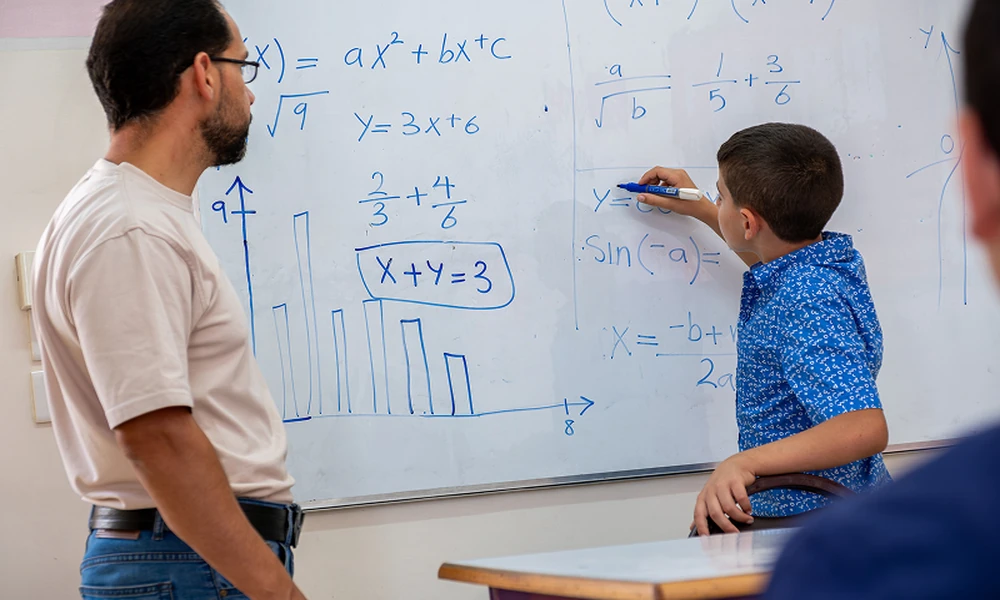
A student who did perfectly fine in primary school maths can hit Secondary 1 and suddenly feel like the subject changed underneath them. It kind of did. Primary maths rewards careful calculation and following a method correctly. Secondary maths starts asking for something closer to abstract reasoning, and that shift catches a lot of otherwise capable students off guard in the first few months.
Why Algebra Changes the Whole Game
The jump from arithmetic with known numbers to algebra with unknowns is bigger than it looks on paper. A student who could reliably solve a word problem by trial and substitution in Primary 6 suddenly has to manipulate symbols that represent values they don’t yet know, following rules that feel more like logic than arithmetic. That’s not a small adjustment, and it’s one reason a student’s confidence can dip even when their underlying ability hasn’t changed at all.
A dedicated maths tuition class that specifically targets this transition, rather than just working through whatever topic the school is covering that week, tends to catch the gap before it compounds across the rest of secondary school.
What a Transition-Focused Class Drills
At Simply Education, the approach leans on an in-house curriculum built around the current Singapore syllabus, with lessons designed to be engaging and participatory rather than purely lecture-style, and tutors who adapt their explanations to how a specific student learns best rather than running one fixed script for the whole class. For the algebra transition specifically, that usually means slowing down on the foundational manipulation skills before moving into the more complex multi-step problems that build on top of them.
That pacing matters because a student who gets pushed into complex equations before the basic manipulation rules feel automatic tends to compound small errors rather than catching them, which is part of why confidence can dip even in a student who’s genuinely capable of the material once it’s explained at the right pace.
This is also where good secondary tuition earns its keep over a generic homework-help session, since the format of secondary maths papers, with working marks, multi-step questions, and less partial credit for a right final answer reached the wrong way, rewards a different kind of exam discipline than primary school tests did, and that discipline has to be taught deliberately rather than picked up on its own.
Signs a Student Is Genuinely Stuck, Not Just Adjusting
A bit of friction in the first term of Secondary 1 maths is normal and usually resolves on its own as a student gets used to the new style of thinking. A few signs suggest the gap needs more deliberate attention instead of just time:
- Homework that used to take 20 minutes now regularly stretches past an hour.
- A student who can follow a worked example in class but can’t reproduce the method independently at home.
- Test scores that are inconsistent from one topic to the next rather than steadily improving.
Why Regular Homework Still Matters at This Level
It’s tempting to assume secondary maths is mostly about understanding concepts and that practice volume matters less than it did in primary school. The opposite tends to be true. Algebraic manipulation, geometry proofs, and multi-step word problems all improve mainly through repetition, since a student needs enough reps to recognise a problem type quickly under exam time pressure rather than working it out from first principles every time.
Regular homework that’s actually reviewed and corrected, rather than just assigned and collected, tends to be the difference between a student who plateaus and one who keeps closing the gap steadily across the year. A tutor who checks working line by line, not just the final answer, can usually spot exactly where a student’s method goes wrong, which matters since the same small mistake tends to repeat itself across several questions once it takes hold. It’s also the kind of detail that generic maths tuition, built around whatever the school happens to be covering that week rather than a specific student’s weak spots, tends to miss.
Thinking About the Bigger Picture
Maths tuition at the secondary level works best when it’s treated as an ongoing partnership between the student, the parents, and the tutor rather than a one-off fix for a bad test result. A student who’s struggling in Secondary 1 isn’t necessarily weaker at maths than one who isn’t. They may just be hitting the abstract-reasoning wall a term or two earlier, and the right support at that point tends to matter more than the grade on any single test. Secondary tuition that treats that early stumble as useful information, rather than a red flag, tends to produce a calmer, steadier student by the time the bigger exams arrive.
Noticing the Secondary 1 maths gap show up at home already? Contact Simply Education to ask about a trial lesson at a branch near you.