

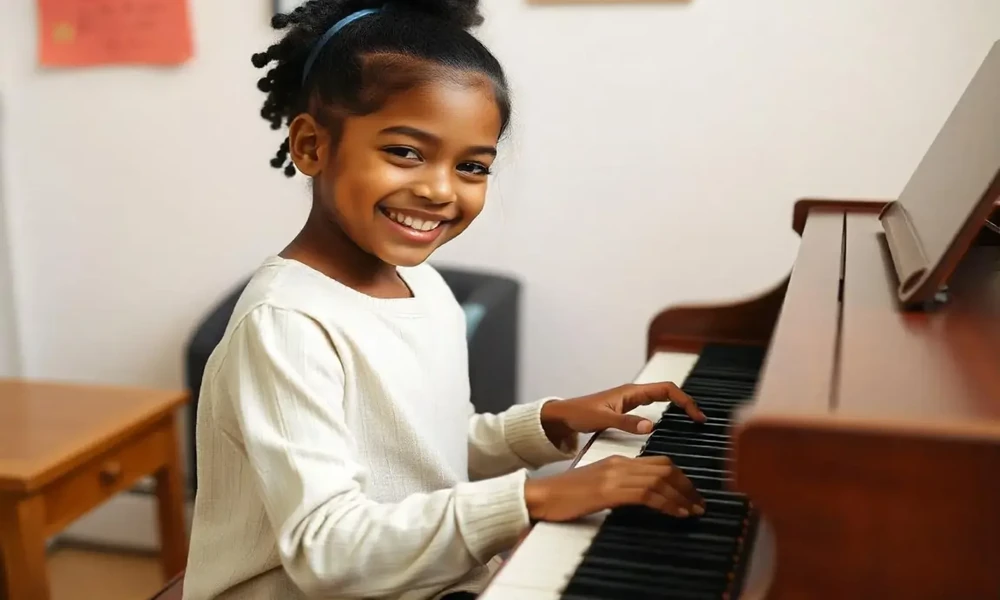
The common assumption is that adults learn a new instrument more slowly than children, which is only half true. Adults typically grasp music theory and structure faster than young children, because they already understand abstract concepts like fractions and pattern recognition that underpin rhythm and key signatures. What actually slows adult progress is different: self-consciousness about sounding bad, stiffer hands from years of typing or manual work, and far less available practice time than a child with a school routine. A realistic guide to piano lessons for adults in Singapore starts from these actual obstacles rather than from the myth that adults simply learn slower across the board.
What Adults Actually Learn Faster Than Children
Adults typically pick up theory concepts, key signatures, and rhythmic subdivision faster than young children, since these rely on abstract reasoning that develops with age. An adult can also self-correct more effectively once a mistake is explained, needing fewer repetitions of the same correction than a young child often does. The instrument’s physical demands are what level the playing field, not the learning itself.
The Real Obstacles Adult Beginners Face
Years of typing or manual work leave many adults with stiffer fingers and less natural hand flexibility than a child just starting out, which shows up in early exercises that require finger independence. Self-consciousness compounds this, since adults are more aware than children of sounding imperfect and more likely to avoid practising within earshot of others, which quietly reduces actual practice time.
Choosing a Teacher Experienced With Adults
A teacher used mainly to teaching children may default to a slower pace on theory than an adult needs, while underestimating how much the physical stiffness issue matters. Look for a teacher who explicitly teaches adult beginners as a distinct group with different needs rather than one who simply runs the same children’s curriculum at a faster pace, since the actual obstacles adults face are different in kind, not just in degree.
Repertoire Choices That Keep Motivation High
Method-book exercises rarely motivate an adult the way they can motivate a child working toward a sticker chart, so most adult programmes blend technical exercises with a piece the student actually wants to play, even if simplified. Choosing repertoire the student recognises and enjoys, arranged at an appropriate difficulty, sustains motivation through the technically unglamorous early months far better than exercises alone.
How Much Practice Time Realistically Works
Fifteen to twenty minutes most days produces steadier progress than a single ninety-minute session once a week, since motor learning on an instrument depends on frequency more than total duration. Adults juggling full-time work should set this expectation with their teacher explicitly, since a mismatch between assigned practice and actual available time is the single most common reason adult students quietly stop attending.
Digital Piano Versus Acoustic for Beginners
A digital piano with a weighted, graded-hammer action is a reasonable starting instrument and solves the practical problem of practising quietly in an apartment, provided the key action is not so light that it fails to build real finger strength. An acoustic piano offers richer tone and more nuanced dynamic control, but for many adults the deciding factor is simply which instrument they will actually have space and tolerance to practise on regularly, and a digital instrument with headphones removes the noise concern entirely for anyone sharing a flat.
Learning Theory Alongside Playing
Understanding why a chord progression works, rather than only where to place the fingers, tends to accelerate an adult’s ability to learn new pieces independently once formal lessons taper off. A teacher who integrates basic theory into every lesson, rather than treating it as a separate, optional add-on, is building a skill that outlasts any single piece of repertoire.
Group Workshops as a Supplement
Occasional group workshops, whether focused on music theory, ensemble playing, or a specific technique, expose adult students to other learners at a similar stage, which reduces the isolation that self-taught practice can create. These are rarely a substitute for regular one-to-one lessons, but they add a social dimension that keeps some adult learners engaged for longer than solo lessons alone would, and hearing other beginners’ honest struggles is often reassuring in itself.
Tracking Progress Without a Formal Exam Path
Many adult learners have no interest in sitting graded exams, which removes the built-in benchmark a younger, exam-track student has. In its place, a good teacher sets informal but specific milestones: a target tempo, a piece learned from memory, a particular technical hurdle cleared, so that progress remains visible even without a certificate at the end of it.
Getting Started Without Overthinking It
The practical route into piano lessons for adults in Singapore is simpler than the obstacles above might suggest: find a teacher who has actually taught adults before, agree on a practice schedule that fits a real working life, and start on whatever instrument is available rather than waiting for the perfect one. Adults who start this way tend to stick with it longer than those who spend months researching the theoretically ideal setup first.