

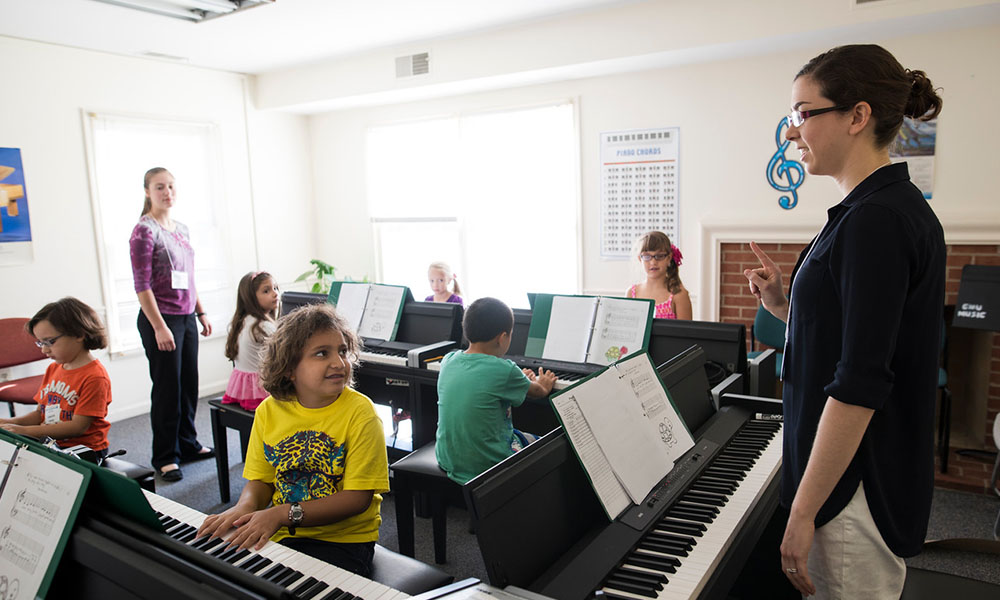
A piano class for kids begins not with music theory or finger exercises, but with a simple question that every parent and instructor must answer: when is a child ready to learn? Walk into any music school on a Saturday morning in Singapore, and you will observe something remarkable. In one room, a five-year-old carefully places coloured stickers on piano keys, matching them to corresponding dots on sheet music. Next door, a seven-year-old reads standard notation whilst playing a simplified Mozart piece. Down the corridor, a ten-year-old works through jazz chord progressions. Each child inhabits a different stage of musical development, yet all are learning piano. The journey, it turns out, depends as much on developmental readiness as it does on desire.
The Developmental Timeline: When Children Can Begin
The human hand develops in stages that directly influence a child’s capacity to play piano effectively. Before age four, most children lack the finger independence and fine motor control required for traditional instruction. Their hands are still growing, their attention spans remain brief, and abstract concepts like musical notation prove difficult to grasp.
Between ages four and six, certain physical and cognitive milestones make learning possible:
- Fingers develop sufficient strength to press keys with control
- Hand-eye coordination reaches levels necessary for reading and playing simultaneously
- Attention spans extend to twenty or thirty minutes of focused activity
- Pattern recognition abilities emerge, allowing children to understand musical sequences
Instructors in Singapore note that “the optimal starting age varies considerably between individual children, with some four-year-olds demonstrating readiness whilst others benefit from waiting until age six or seven.” This observation reflects a fundamental truth about childhood development: chronological age and developmental age do not always align precisely.
Methodological Approaches: How Young Students Learn Differently
The pedagogy of children’s piano instruction differs substantially from adult teaching methods. Where adults can process abstract concepts and follow verbal explanations, children require concrete, experiential learning. Several established methods have emerged over decades of teaching practice, each with distinct philosophical foundations.
The Suzuki method emphasises ear training and repetition, mirroring how children acquire language. Students learn pieces by listening and imitation before reading notation. This approach builds musical instinct but may delay sight-reading development.
The Faber method employs a more balanced approach:
- Simultaneous development of reading, listening, and technical skills
- Age-appropriate repertoire with familiar melodies
- Theory concepts integrated through creative activities
- Regular performance opportunities to build confidence
Traditional methods prioritise notation reading from the earliest lessons, establishing strong sight-reading foundations but potentially sacrificing initial enjoyment for some students.
In Singapore’s diverse music education landscape, many schools report that “blending methodological approaches based on individual student responses produces better long-term outcomes than rigid adherence to single systems.” This flexibility acknowledges that children, like the geological formations John McPhee so carefully describes, form through varied processes that defy simple categorisation.
Group Versus Private Lessons: The Social Dimension
The structure of piano class for kids significantly influences learning outcomes. Group classes create social environments where children observe peers, develop healthy competition, and experience collaborative music-making. A child struggling with rhythm may suddenly grasp the concept after watching a classmate succeed. The group dynamic provides motivation that solitary practice cannot replicate.
Private instruction offers different advantages:
- Individualised pacing that accommodates accelerated or delayed development
- Immediate correction of technique before poor habits solidify
- Flexibility to explore musical interests beyond standard curriculum
- Undivided attention to questions and challenges
Some families choose hybrid approaches, combining weekly private lessons with monthly group workshops. This structure provides technical development whilst maintaining social engagement with fellow young musicians.
Physical Considerations: Instruments and Ergonomics
The relationship between child and instrument requires careful attention. Full-sized piano keys prove manageable for most children by age five or six, but younger students may struggle with hand spans and finger reach. Some instructors recommend specific exercises:
- Finger strengthening activities using playdough or stress balls
- Hand position games that make proper technique engaging rather than tedious
- Modified repertoire that accommodates smaller hands without sacrificing musical quality
Digital keyboards serve many families well during initial learning years, offering volume control, recording capabilities, and space efficiency. However, weighted keys that simulate acoustic piano action prove essential for developing proper touch and dynamics.
Practice Strategies: Building Sustainable Habits
The challenge of consistent practice shapes every young student’s progress. Unlike adults who understand delayed gratification, children require immediate rewards and engaging practice structures. Successful families establish routines that integrate piano into daily life rather than treating it as an isolated chore.
Effective practice frameworks include:
- Short, focused sessions of fifteen to twenty minutes rather than extended marathons
- Varied activities within each session, preventing boredom through diversity
- Parent involvement that provides encouragement without pressure
- Clear, achievable weekly goals that create momentum
Singapore’s music educators frequently observe that “children who practice at consistent times each day, regardless of duration, progress more steadily than those with irregular, longer sessions.” The pattern mirrors findings in numerous skill acquisition studies: regularity trumps intensity.
Age-Specific Repertoire and Expectations
Musical literature for young pianists has expanded dramatically in recent decades. Composers now create pieces specifically calibrated to children’s technical abilities whilst maintaining musical substance. Five and six-year-olds might begin with simple folk melodies spanning five notes. By age eight or nine, students typically manage pieces with both hands playing independent melodic lines. Ten and eleven-year-olds often explore simplified classical works and contemporary compositions requiring more sophisticated interpretation.
Realistic expectations prove crucial for maintaining enthusiasm. Most children require two to three years before performing recognisable pieces with fluency. Rushing this timeline risks frustration and abandonment of lessons entirely.
For families considering musical education, understanding developmental readiness, methodological options, and realistic timelines helps ensure that enrolling in a piano class for kids becomes the beginning of a lifelong musical relationship rather than a brief, frustrating experiment.